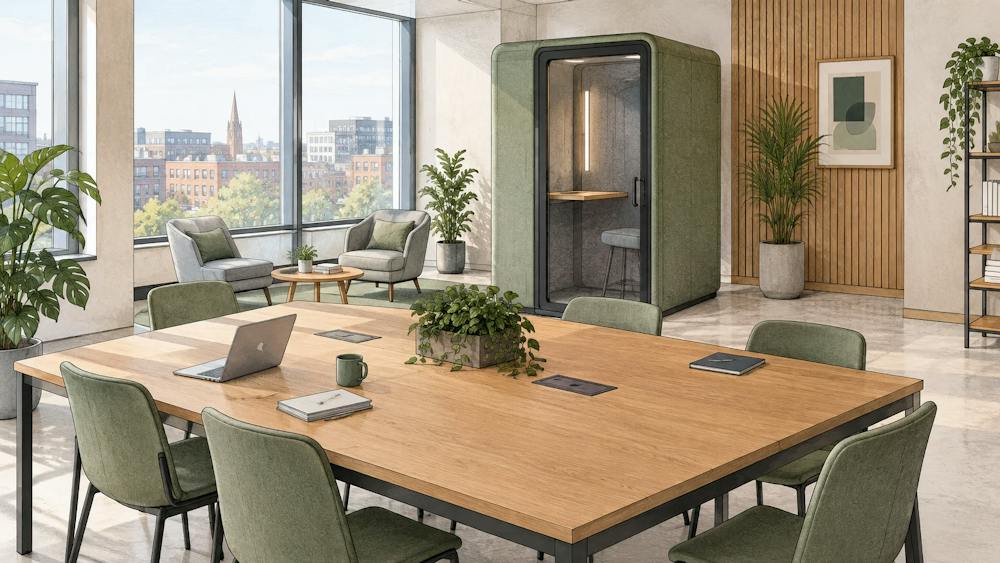
What makes a journey into the office worth the time? For many teams, the answer is no longer a desk alone, but a place to focus, meet colleagues or share ideas. That shift is changing the post-pandemic office from a default daily destination into a workplace designed around what people need to do there. If you are weighing local workspace options, our guide to flexible office space in Birmingham gives you a starting point for considering different ways to work.
Hybrid work is now a lasting part of the UK picture, although not every role or worker has the same options. The House of Lords Library, citing Office for National Statistics data for April to June 2025, says 13% of working adults in Great Britain worked from home all the time and a further 26% did so some of the time. Those figures are a dated snapshot, but they underline why office plans need to account for people who attend on different days.
What is the office for when people work in different places?

Picture an office day filled with video calls, focused tasks and a team meeting. If the space offers only rows of desks, it may not serve any of those activities especially well. A considered workplace purpose helps you match the office to the work people come in to do, rather than assuming every task belongs at a fixed desk.
That means balancing collaboration spaces with quieter settings for concentration, private calls and confidential conversations. It also means making it straightforward for in-office and remote colleagues to take part in the same meeting. A 2026 University of Birmingham study involving more than 800 UK businesses found that 88% had adopted remote working since the pandemic, with most sustaining or expanding remote and hybrid practices. The finding describes surveyed businesses, rather than every employer, but it reinforces the need to plan for varied work patterns.
For a team, the practical question is whether people can find the right setting when they need it. Our comparison of private offices versus coworking spaces can help you weigh dedicated space against a shared working environment.
How can you balance collaboration and focused work?
A useful layout gives different work modes room to coexist. Teams may need meeting rooms for discussion, shared areas for informal exchanges and quieter spaces for tasks that require concentration. Where hybrid meetings are common, check whether rooms support clear audio and screen sharing, and whether remote participants can see and hear everyone in the room.
Do not assume that an open-plan layout will suit every task. Noise, interruptions and a lack of visual privacy can make focused work difficult, while too many enclosed rooms may leave teams without comfortable places to collaborate. Consider how people actually use the space, then adjust the balance of focus areas, shared tables and meeting settings as needs become clearer.
Which changes make a workspace more comfortable to use?
Comfort comes from the everyday details as well as the floor plan. Natural light, suitable furniture, pleasant break areas and reliable meeting equipment can all influence how a space feels during a working day. A wellbeing-focused design should also make it easy to step away from a screen, take a break or move between types of work.
Review the essentials before adding extras: lighting, seating, temperature, acoustics, access to refreshments and places to take a private call. Then consider which additional facilities genuinely support your team’s routine. For a broader planning checklist, see our checklist of modern workspace amenities.
In Birmingham, organisations can also consider whether everyone needs the same kind of office access. At BLOCK Birmingham, private offices provide dedicated workspace, while collaborative coworking areas and lounges offer shared alternatives. Flexible membership packages support ongoing access, and Day Passes are available for occasional use. BLOCK Birmingham is open 24 hours a day, which can suit people whose working hours do not follow a conventional schedule.
How should you plan space around changing attendance?
Start with the days and times your team is actually likely to attend. Look for recurring busy periods, quiet days and overlapping schedules, then ask whether the space still works at peak attendance. The British Council for Offices’ UK utilisation review describes a shift from the long-standing 80% benchmark towards a more realistic utilisation rate of about 66%. Treat that figure as a sector benchmark, not as a target for every organisation or a measure of Birmingham offices specifically.
Use your own observations and employee feedback to decide what to change. If a desk area is often empty while meeting rooms are consistently hard to find, your layout may need a different mix. Flexible furniture, shared settings and suitable rooms can help a workplace adapt without assuming attendance will be uniform throughout the week.
Before changing the layout, check how people experience the current space. Ask which tasks are difficult in the office, where interruptions occur and what would make in-person days more useful. Practical answers can guide improvements more effectively than choosing a design trend first.
How do amenities support the working day?
Amenities matter when they respond to everyday needs, rather than serving as decoration. Comfortable places to take breaks, coffee facilities, bike storage or fitness options may be useful, depending on how people travel and spend their day. The value of each feature depends on your team’s routines and the work the space needs to support.
When evaluating options, compare the facilities with the working pattern you want to enable. Our article on office perks that improve the workday explores how to think about those additions. A clear purpose helps you prioritise practical comfort and access over amenities that your team may rarely use.
For teams that need to gather without taking out an ongoing workspace membership, meeting facilities can also be relevant. BLOCK Bristol has meeting rooms available to members and non-members, with multiple rooms accommodating up to six people and a boardroom for up to 20. These facilities are in Bristol, so check the location and suitability for your meeting before making plans.
Make the office earn its place
A post-pandemic office is most useful when its layout, access and amenities reflect the work people need to do there. Start by understanding attendance and task needs, then make room for focused work, collaboration and everyday comfort. For organisations in Birmingham, reviewing those priorities can help clarify whether a fixed office, shared workspace or a mix of options is the more practical fit.
Find a workspace that fits your working pattern
If your team is balancing home working with time together, consider which workspace format best matches your need for dedicated desks, shared areas or occasional access. At BLOCK Birmingham, you can choose between private offices, coworking areas, lounges, flexible membership packages and Day Passes.
BLOCK Birmingham is open 24 hours a day. Explore workspace options in Birmingham to consider the available formats and find a starting point for your team’s requirements.
Frequently Asked Questions
What does a post-pandemic office need to provide?
It should support the tasks people come in to do, including focused work, meetings and team collaboration. The right mix depends on your organisation’s work patterns and employee needs.
How can an office support hybrid teams?
Provide settings for both individual and group work, and make sure meetings include colleagues joining remotely. Reviewing attendance patterns can help you decide how much space to allocate to each activity.
Are open-plan offices suitable for focused work?
They can support interaction, but noise and interruptions may make some tasks harder. Consider adding quieter areas or private spaces for concentration and calls.
Can you use BLOCK Birmingham occasionally?
BLOCK offers Day Passes for people who need workspace for a day or on an occasional basis. The detailed inclusions and price are not specified here, so check with the workspace before planning your visit.
What should you assess before redesigning an office?
Start with attendance patterns, the tasks employees perform and feedback about the current space. Then review the balance of focus areas, meeting rooms, shared settings and useful amenities.