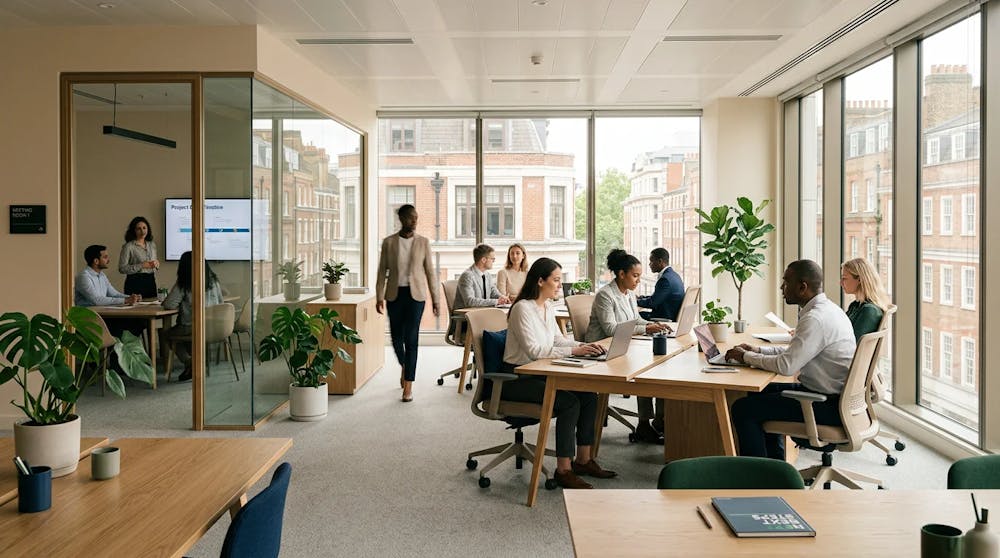
Two-thirds of UK employers now expect staff in the office at least part of the week, and that shift has quietly rewritten how growing teams shop for space. For a business of ten, twenty or fifty people, the question is rarely whether to have an office; it is which model delivers control without the burden of a decade-long lease. If you are weighing your options, our serviced offices guide is a useful starting point for understanding the landscape.
The demand for a dedicated private office space for 10 to 50 people has become one of the sharpest trends in commercial property. According to Mordor Intelligence, the UK flexible office market is estimated to grow from USD 4.19 billion in 2026, driven by employers embedding hybrid working into long-term real-estate strategy. For teams in this size bracket, that maturing market translates into more choice, clearer pricing and better-quality buildings.
Why mid-sized teams are choosing flexible private offices
A team of 10 to 50 sits in an awkward gap. It is too large for a handful of hot desks, yet often too cautious to sign a conventional lease that locks in fixed costs for ten to fifteen years. A dedicated private office within a flexible workspace resolves that tension by offering a lockable, brandable space on terms that scale with headcount.
The structural drivers are firmly in place. Mordor Intelligence data notes that average UK office utilisation reached 66% in 2025, prompting companies to shift from fixed leases toward variable-cost desks that can expand or contract with headcount. For a scaling business, that ability to adjust space quarter by quarter is often worth more than a marginally lower headline rent.

What a private office for a growing team includes
Picture a team of thirty moving in on a Monday morning: desks in place, internet live, meeting rooms bookable and reception staffed. That "plug-and-play" readiness is the defining feature of a serviced private office, where rent, utilities, cleaning and facilities are typically rolled into a single monthly payment.
Standard provisions for a mid-sized suite usually include the following:
- A lockable, private suite sized to your headcount, often customisable with your branding.
- All-inclusive billing covering business rates, service charges and utilities.
- Shared meeting rooms and breakout space, bookable by the hour or day.
- Secure 24-hour access, high-speed internet and on-site management.
- Wellbeing amenities such as cafes, gyms, roof terraces and phone booths.
These amenities are increasingly the deciding factor rather than a bonus. If you want a closer look at how dedicated suites sit within shared buildings, our explainer on private offices in coworking hubs sets out how the two models complement each other.
How much does a private office for 10 to 50 people cost?
Pricing is usually quoted per desk per month, which makes it straightforward to model at different headcounts. Location remains the single biggest variable. According to Savills research, average desk rates in London reached £841 per desk at the end of H1 2025, representing 5% growth from the end of 2024, with the capital holding the highest average prime desk rate of any global centre.
Regional markets offer considerably more value. CoworkingCafe data for Q1 2026 places the UK-wide median monthly coworking membership at £180, with cities such as Bristol, Manchester, Glasgow and Leeds clustering tightly in the £192 to £195 band. For a private suite, expect a premium above these open-desk figures, but the geographic gap between London and the regions remains substantial.
When you build a budget, factor in more than the desk rate. Meeting-room credits, parking, additional bandwidth and the length of your commitment all shape the true monthly figure. Our guide on how to rent office space walks through the full cost picture before you sign.
Serviced, managed or leased: choosing the right model
Teams of this size typically choose between three structures. Each balances flexibility against cost and control differently, and the right answer depends on how confident you are about your headcount over the next two years.
| Model | Typical term | Flexibility | Best suited to |
|---|---|---|---|
| Block Workspace (serviced, flexible membership) | Rolling / short | High: ultra flexible packages, transparent all-inclusive pricing | Growing teams of 10 to 50 wanting choice and no hidden costs |
| Serviced office (generic) | 6 to 12 months | High, all-inclusive | Smaller teams prioritising cost control |
| Managed office | 1 to 3 years | Medium, tailored fit-out | Established teams wanting a bespoke space |
| Conventional lease | 5 to 15 years | Low, fixed commitment | Large, stable headcounts |
The market is moving decisively toward the flexible end. CoStar analysis reports that corporates now represent 47% of global flex office occupancy, up from 13% in 2020, and that demand for high-quality managed space up to 5,000 square feet has surged. For a team that values agility over fixed-asset commitment, a serviced or managed private office is the natural fit. Where flexibility and choice matter most, our ultra flexible membership packages are designed to expand or contract as your team does.
Larger suites are where occupancy is strongest
Counterintuitively, bigger private suites are proving harder to secure than small ones. The Instant Group reports that UK flex space averaged 80% occupancy, while spaces over 30,000 square feet reached 89%, a full ten percentage points higher than smaller floors. That signals a genuine shortfall in larger, ready-to-occupy supply.
The same research highlights that businesses increasingly seek a combination of private and open-access space to accommodate fluctuating demand and company growth. For a team of 10 to 50, this means viewing suites early and acting decisively, because the most amenity-rich options in strong locations are frequently the first to be taken.

Supply constraints and why location still wins
Availability is tightening at the quality end. K2 Space reports that new London office completions are forecast to fall sharply in 2026, with only around 1.2 million square feet of new space expected, roughly a 40% decline on 2025, and approximately 70% of that already pre-let. Constrained supply of the best buildings means competition for well-connected, high-specification space will intensify.
Proximity to transport remains the deciding amenity for most occupiers. Savills research found that 84% of respondents rated closeness to public transport a top factor in an ideal workplace. When you shortlist buildings, weigh commute times, station access and the strength of the surrounding professional community as heavily as the desk rate itself.
How to secure the right space for your team
Begin with an honest headcount forecast for the next eighteen to twenty-four months, then add a modest buffer for growth. A suite that fits perfectly on day one can feel cramped within two quarters, so a model that allows you to add desks matters as much as the current price.
Next, compare the total monthly cost, not just the per-desk figure, and confirm exactly what is included. Transparent, all-inclusive pricing removes the uncertainty of separate service charges and utility bills. If you are still clarifying terminology as you compare providers, our overview of what is a serviced office explains the essentials before you commit.
Making a confident decision
Choosing a private office for a team of 10 to 50 people in 2026 is ultimately a balance of flexibility, cost transparency and location quality. The evidence points one way: larger suites are in demand, supply of the best buildings is tightening, and businesses increasingly favour models that flex with headcount rather than locking in fixed commitments. Forecast your growth realistically, compare total monthly costs rather than headline desk rates, prioritise transport links and amenities, and view your shortlist early. A workspace that adapts as your team evolves protects both your budget and your ability to change course.
Take action with Block Workspace
Finding a home for a team of ten, thirty or fifty does not need to mean rigid leases or unexpected charges. We provide stylish, dynamic workspaces with ultra flexible membership packages and transparent options, so you can choose the setup that fits your stage of growth without hidden costs or surprises.
Across Bristol, Plymouth and Taunton, our members enjoy vibrant networking communities alongside perks such as yoga studios, roof terraces, gyms and cafes. Explore our large private office spaces and daily coworking options to give your team a professional base that grows with you.
Frequently Asked Questions
How much space does a team of 10 to 50 people need?
As a general guide, allow between 50 and 100 square feet per person, depending on layout and how many collaborative zones you require. A serviced or managed suite removes the guesswork, as providers size private offices to your headcount. Adding meeting rooms and breakout areas through shared facilities keeps your dedicated footprint efficient.
Is a serviced office cheaper than a conventional lease?
For most teams of this size, a serviced office is more cost-efficient once fit-out, business rates, utilities and management are factored in. All-inclusive monthly pricing bundles these into one predictable payment. A conventional lease may offer lower net rents at scale, but it carries higher upfront costs and far less flexibility.
What amenities should a mid-sized private office include?
Look for secure 24-hour access, fast internet, bookable meeting rooms, breakout space and on-site management as standard. Wellbeing perks such as cafes, gyms and roof terraces increasingly influence talent retention. Our workspaces in Bristol, Plymouth and Taunton combine private offices with these amenities and active networking communities.
Can a flexible office scale as our team grows?
Yes, and this is one of the strongest arguments for the model. Flexible membership packages allow you to add desks or move to a larger suite as headcount changes. That agility is why many growing UK businesses now favour serviced and managed offices over long fixed leases.
Which UK cities offer the best value for private offices?
Regional cities generally offer considerably lower desk rates than London while still providing high-quality, amenity-rich buildings. According to Q1 2026 data, monthly memberships in cities such as Bristol, Manchester and Leeds cluster well below London prices. Balancing cost against transport links and talent access is key when choosing a location.